Interactive online version:

Train an image classifier
In this tutorial, we show how to train a simple convolutional neural network (CNN) to classify hand-written digits from the MNIST dataset.
[1]:
import math
import tensorflow_datasets as tfds
import matplotlib.pyplot as plt
import jax
import jax.numpy as jnp
import pax
import opax
from absl import logging
[2]:
logging.set_verbosity(logging.FATAL)
pax.seed_rng_key(42)
learning_rate = 1e-4
batch_size = 128
num_training_steps = 1000
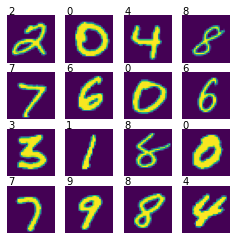
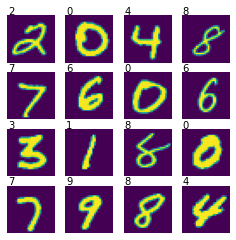
First, we will load the MNIST dataset using tensorflow_datasets library and show a few examples.
[3]:
mnist_data = tfds.load("mnist")
[4]:
def plot_image_grid(images, labels):
    N = len(images)
    size = int(math.sqrt(N))
    plt.figure(figsize=(size, size))
    for i in range(N):
        plt.subplot(size, size, i + 1)
        plt.imshow(images[i, ..., 0])
        plt.text(0, -1, labels[i])
        plt.axis("off")
    plt.show()
[5]:
batch = next(mnist_data["test"].take(16).batch(16).as_numpy_iterator())
plot_image_grid(batch["image"], batch["label"])
Now, we will use PAX to implement a simple CNN model:
[6]:
net = pax.Sequential(
    pax.Conv2D(1, 32, 5, stride=1, padding="VALID"),
    jax.nn.relu,
    pax.Conv2D(32, 64, 5, stride=2, padding="VALID"),
    jax.nn.relu,
    pax.Conv2D(64, 128, 3, stride=2, padding="VALID"),
    jax.nn.relu,
    pax.Conv2D(128, 10, 4, stride=1, padding="VALID"),
    lambda x: x.reshape((x.shape[0], -1)),
)
We use pax.Sequential to define a module as a sequence of computational steps.
[7]:
print(net.summary())
Sequential
├── Conv2D(in_features=1, out_features=32, kernel_shape=(5, 5), padding=VALID, with_bias=True, data_format=NHWC)
├── x => relu(x)
├── Conv2D(in_features=32, out_features=64, kernel_shape=(5, 5), padding=VALID, stride=(2, 2), with_bias=True, data_format=NHWC)
├── x => relu(x)
├── Conv2D(in_features=64, out_features=128, kernel_shape=(3, 3), padding=VALID, stride=(2, 2), with_bias=True, data_format=NHWC)
├── x => relu(x)
├── Conv2D(in_features=128, out_features=10, kernel_shape=(4, 4), padding=VALID, with_bias=True, data_format=NHWC)
└── x => <lambda>(x)
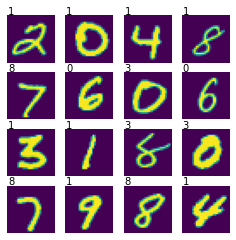
Next, we plot the predictions of the untrained model as a simple sanity check. Note that we are normalizing MNIST images to the range of \([-1, 1]\), which is a preferred range for neural nets.
[8]:
images = batch["image"].astype(jnp.float32) / 255.0 * 2.0 - 1.0
logits = net(images)
labels = jnp.argmax(logits, axis=-1)
plot_image_grid(images, labels)
We will use a cross-entropy loss function to train our model.
[9]:
def loss_fn(model: pax.Module, inputs):
    images, labels = inputs["image"], inputs["label"]
    images = images.astype(jnp.float32) / 255.0 * 2.0 - 1.0
    logits = model(images)
    log_prs = jax.nn.log_softmax(logits)
    log_prs = jax.nn.one_hot(labels, num_classes=logits.shape[-1]) * log_prs
    log_pr = jnp.sum(log_prs, axis=-1)
    loss = -jnp.mean(log_pr)
    return loss
We need an update function that represents a single training step.
[10]:
@jax.jit
def update_fn(model: pax.Module, optimizer: opax.GradientTransformation, inputs):
    loss, grads = jax.value_and_grad(loss_fn)(model, inputs)
    model, optimizer = opax.apply_gradients(model, optimizer, grads=grads)
    return model, optimizer, loss
We use the opax.apply_gradients function to update both the model and the optimizer.
Now, let’s create a data loader.
[11]:
dataloader = (
    mnist_data["train"]
    .repeat()
    .shuffle(100 * batch_size)
    .batch(batch_size)
    .take(num_training_steps)
    .prefetch(1)
    .enumerate(1)
    .as_numpy_iterator()
)
We will use adam optimizer from opax library.
[12]:
optimizer = opax.adam(learning_rate).init(net.parameters())
Finally, let’s train our model.
[13]:
total_losses = 0.0
for step, inputs in dataloader:
    net, optimizer, loss = update_fn(net, optimizer, inputs)
    total_losses = loss + total_losses
    if step % 100 == 0:
        loss = total_losses / 100
        total_losses = 0.0
        print(f"[step {step:>4}]  loss {loss:.3f}")
[step  100]  loss 1.153
[step  200]  loss 0.363
[step  300]  loss 0.271
[step  400]  loss 0.201
[step  500]  loss 0.180
[step  600]  loss 0.145
[step  700]  loss 0.133
[step  800]  loss 0.118
[step  900]  loss 0.116
[step 1000]  loss 0.100
Let’s plot the predictions of our trained model on the test set as a simple sanity check.
[14]:
batch = next(mnist_data["test"].take(16).batch(16).as_numpy_iterator())
images = batch["image"].astype(jnp.float32) / 255.0 * 2.0 - 1.0  # [-1, 1]
logits = net(images)
labels = jnp.argmax(logits, axis=-1)
plot_image_grid(images, labels)